
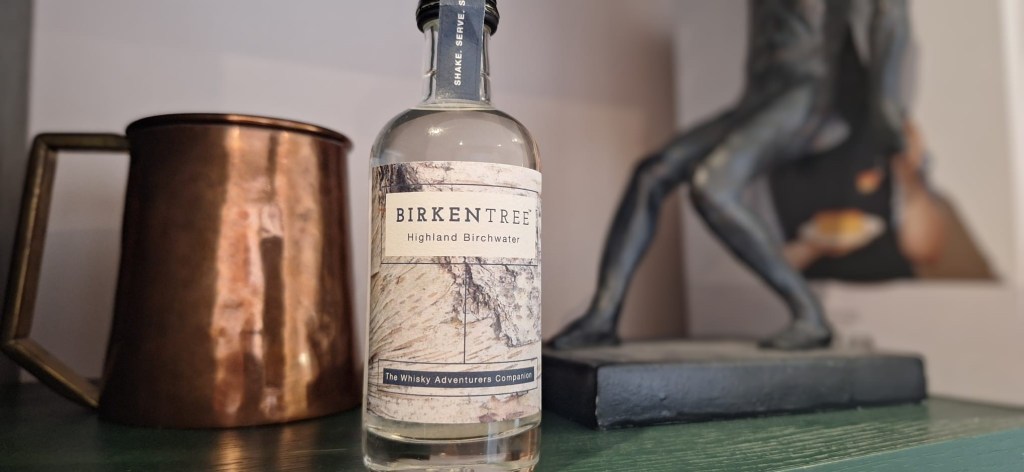
If you’re reading this review of Birkentree’s Highland Birchwater because you’re looking for a gift for a whisky lover that isn’t glassware, whisky stones or a hip flask, then I have good news: Birkentree is a novel and affordable gift that’s fun to experiment with. It won’t end up being lost in a cupboard or snuck off to a charity shop.
For whisky aficionados trying to decide if this is worth investing in regularly, read on.
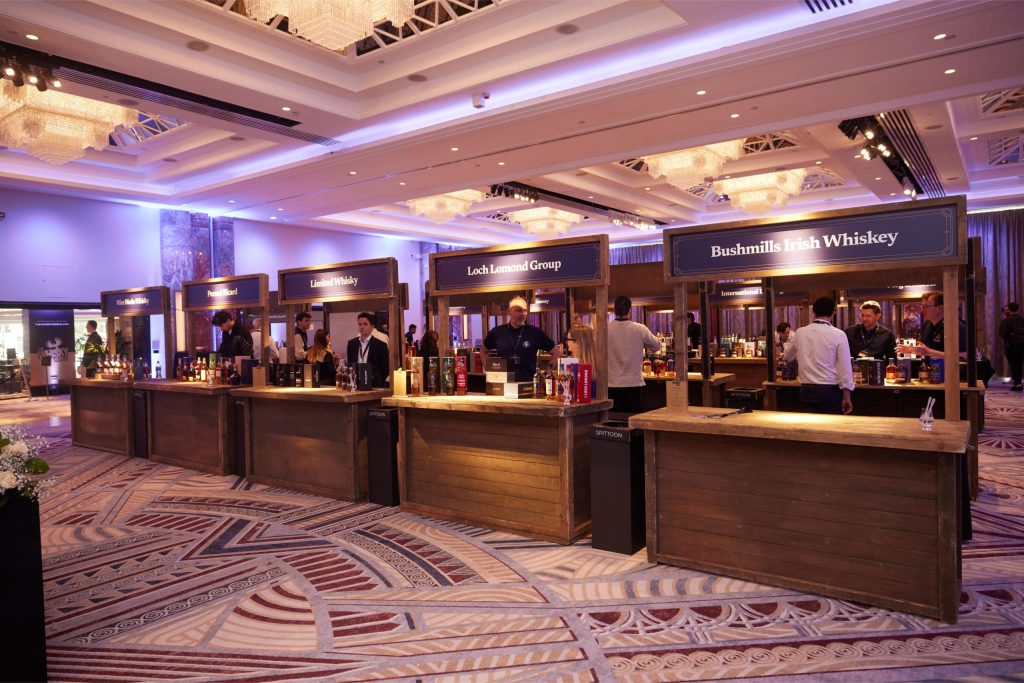
I first tried Birkentree’s Highland Birchwater at Whisky Live where they let visitors try adding this alternative to tap water to whatever whisky they were enjoying from any other stand. However, our methodology was hardly scientific and whilst I noticed a definite difference with one whisky I tried it in, the other didn’t change much. I remained curious and picked up a bottle to try out in the controlled environs of my kitchen.
If you pour yourself out a sip of Birkentree’s Highland Birchwater on its own you’ve got a slightly cloudy liquid that smells faintly of yum yums or Krispy Kreme doughnuts. The taste is minimal too, slight sweetness alongside barely detectable floral note. Think heavily diluted gomme syrup. There is no way this would influence anything but the blandest of whiskies vs the myriad mineral notes of tap waters up and down the country.
Birkentree’s site is full of birchwater history and storytelling which is charming but what really matters is the science. The chemical composition of birchwater (which if you haven’t guessed yet, is water tapped from a birch tree) is nearly all H2O with sugar, acids, enzymes and minerals making up the final fraction. Suffice to say there’s a lot more going on in your Birkentree than there is in your water. All this complexity doesn’t have much flavour but there is a noticeably thicker texture than water.
The Tests
All But Drams is putting Birkentree Highland Birchwater to the test across three distinct whiskies, all with high ABVs and rich flavour profiles that open up with water. The whiskies are all 10ml pours tried three ways:
- Neat
- With 2ml Birkentree
- With 2ml water
This is then followed by adding more water and Birkentree respectively to see if further dilution yields much change.
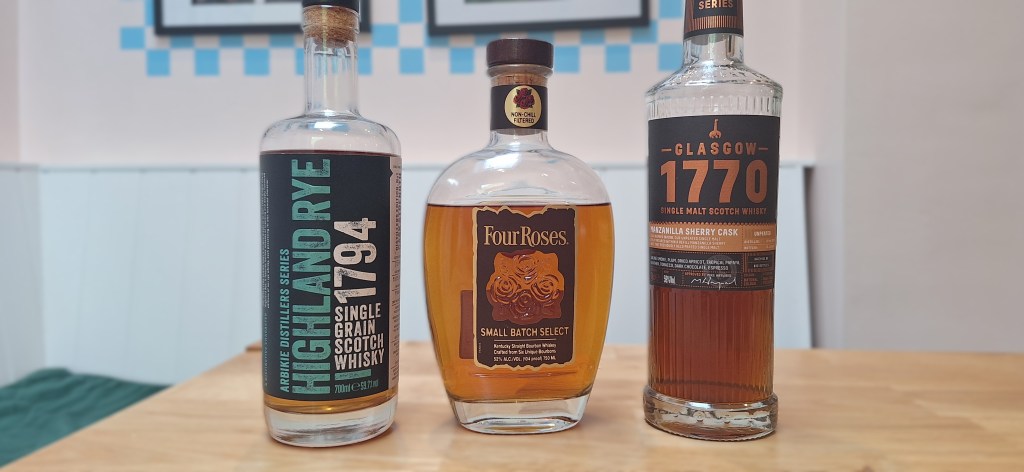
Arbikie 1794 Highland Rye Cask Strength (59.7%)
The standard bottling of Highland Rye is a personal favourite of mine and this cask strength version is much the same, just hitting harder. Taken neat the hot rye spice dominates along with sweet barley. The lemon and black tea notes of the Arbikie profile are there on the finish.
Adding Birkentree really softens the dry and tannic wood spice and brings the lemon to the fore. There’s a chewy leatheryness that I’ve not had before. After sitting with the taste and being stuck on how to describe it I dug out the distillery’s one notes and this is the smoked pear they talk about that I’ve never gotten before. Diluting further still works to bring out the lemon and orange but there’s a minerality that sneaks in too.
Adding water to Arbikie also softens the rye spice but the thinning of the mouthfeel is noticeable and that leathery smoke isn’t there. However neither is the tannic wood. Overall you’ve got a sweet and herbal rye that still feels complex.
Birkentree made Arbikie more interesting but not necessarily better. The dram is too hot for me neat and water tones down the fruitiness. By contrast Birkentree brings the fruit forward at the expense of the woodiness and spices. The difference between water and Birkentree is noticeable but a question of preference and the mood I’m in.
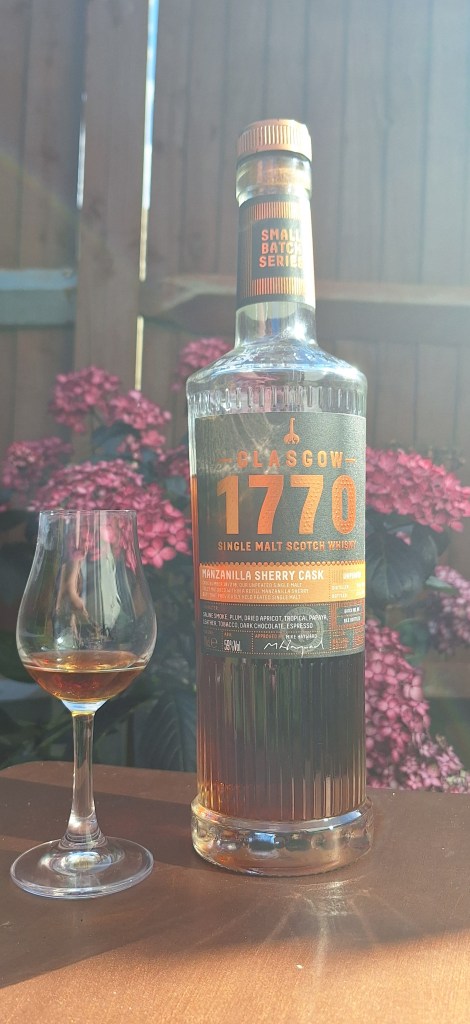
Glasgow 1770 Manzanilla Sherry Cask (59%)
This is a 2024 favourite for many whisky lovers and has long since sold out. It is one of the most complex whiskies in my selection and certainly the most complex one under £60. It frankly needs dilution as the 59% ABV means small sips turn dry and evaporate on the tongue. Still, sampling it neat delivers a whack of sweet but smoky sherry, leaving a finish of rich Christmas cake, toffee, chocolate and dry wood.
Dropping some Birkentree into the whisky amps up the complexity. The mouthfeel is unchanged but the evaporation is halted so that sherry can linger on the finish. At some points during tasting you wouldn’t think this is peated but rather meaty sherry. Fruit cake comes in on the mouth but fades fast.
Further dilution with Birkentree really dials out any peat at all in favour of all the sweet fruit but there’s a saltiness on the finish I’m not a fan of. Water is an interesting one. The mouthfeel difference is here for sure but there’s not much change to flavour. It’s still sweet upfront and leather and smoky sulphur to chew over on the finish.
With this whisky Birkentree just nips ahead, delivering a modest mouthfeel improvement over water.
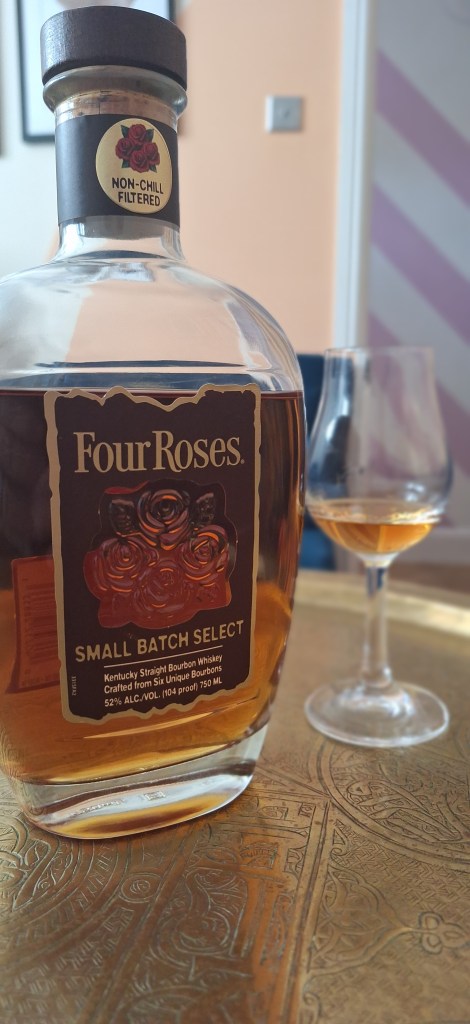
Four Roses Small Batch Select (52%)
Four Roses Small Batch Select is all about that rich high-rye bourbon vanilla and spice combo. It’s here in spades but can be hot and overwhelming. Whilst Birkentree is a Scottish product and the marketing focuses on Scotch the science remains the same regardless of which country your whisky came from. My first Birkentree test at Whisky Live was with Ben Holladay Rickhouse Proof so I wanted to come back and try again with another rich and high ABV bourbon.
Taking it neat is a journey through dry oak, Christmas spices and vanilla. I love it but having tasted across the Four Roses range I know it opens out at lower ABVs.
I am wowed when I add Birkentree. A complex bourbon just got richer. It’s more biscuit and caramel without losing the mouthfeel that I think is perfect at 52%. The Christmas spices like cinnamon and nutmeg are there in the rye heat but there’s dark fruits here too.
Adding more Birkentree brings through sweet vanilla and caramel along with a little minerality. I like it. Being punchy and rye heavy I use Four Roses in boozy cocktails and for a winter drink so this is a fun change. Is it better? Hard to say. It hasn’t become like a lower ABV four Roses either. Tested against my bottle of gentle Four Roses Super Premium the Birkentree’d Small Batch wins out.
What about water? It’s not great. There’s the plastic and mineral notes you would find in the budget Yellow Label bottling coming up on the finish and sticking there. The mouthfeel difference is noticeable but nowhere near as stark as on the Arbikie and the Glasgow. Here Birkentree really does win out over water.

What Else?
So far I’ve heaped praise on Birkentree but we are not looking at revolution here. There is a serious flaw you need to know before you shell out for some bottles. The problem is that Birkentree is a victim of its own natural complexity. It isn’t 100% water and will spoil. Birkentree’s official recommendation is that you finish a bottle within 2 days of opening. I was planning to do these three tastings over the course of a week but had to rush them across three consecutive nights to beat this expiration risk.
Based on my testing a 35ml dram would need around 7ml Birkentree (80:20). The suggested mixing of 50:50 feels ridiculous to me and doesn’t match my tastings. So to optimise your Birkentree you would need to plan to have at least 14 drams within the two days of opening a bottle to use it up. Fine if you’re a group but more than enough to put a solo drinker over their recommended weekly units.
This narrows the optimal use of Birkentree to bars, tasting groups or at a minimum an enthusiastic duo. I can see bottles of birchwater easily spoiling in fridges across the country, which isn’t Birkentree’s fault, but it is their problem to tackle. Birkentree acknowledges this and has put thought into a solution – ice cubes. Measuring out 7ml into my ice cube trays was tedious but it did work. However I had gotten through a good chunk of the bottle in tests, someone who has just cracked it open out of curiosity is going to have a problem.
I’ve continued trying my Birkentree ice slivers with whiskies with mixed results. However, this has led me to find the whisky niche that it boosts the most for my palate – cask strength grain. The best examples are Take It To The Brig by Brave New Spirits and Cadenhead’s Invergordon 16. These cask single grains hit hard with the sherry and grain notes but have a thin mouthfeel despite the 57% and 60.6% respective ABVs. Birkentree works wonders here and brings out the sherry beautifully. Water just dials up the rubber and plastic notes I often find lurking in otherwise delightful grain whiskies.
Does Birkentree work? Yes, but the extent of the success depends on what exact drams you try it with. Will I be committing to Birkentree for my personal use? Probably not, but I’d always be happy to receive some as a gift and I’ll stock some whenever I host a tasting. They take up very little space and having one sealed in the cupboard ready for when you’re getting out your best bottles with friends is a good idea for any whisky fan. I’d love to see more of Birkentree when I’m out at specialist bars too, even if I’m not willing to front up the cash at home for it.



 All But Drams
Leave a comment